
Hi, this is Jiro.
Have you ever taken a toy apart, or even an alarm clock?
I myself have, too, and still do it even these days!
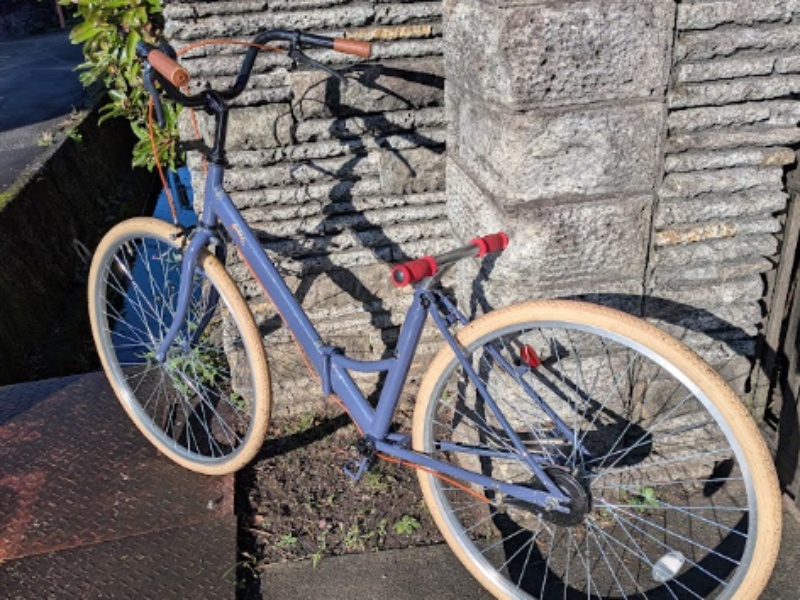
The other day, I removed the pedals, chain, gears, and wire basket from my bike and succeeded in making a special training machine of my own.
While trying different ways of riding it and gliding along on it outside, I suddenly said to myself, “Oh, this is a new kind of scooter!”
As soon as that idea came to mind, the word origin of scooter began to intrigue me so much that I rushed back home on my “scooter” and got absorbed in some fascinating little research.
Here are some of the things I found:
① One possible prehistoric ancestor of the word scooter is a reconstructed root, SKEUD, meaning “to shoot, chase, or throw.” The sound of the word itself may even suggest a sudden, swift movement to you!
② Some other words thought to share this ancient root are shoot, shout, shut, and shuttle. They all seem to suggest a sudden, swift movement and perhaps even a corresponding bodily sensation.
But my little research didn’t stop there. I became curious about the ending -le, too.
③ The little ending -le in shuttle is an old word-forming element. Similar endings can be found in words for tools, such as handle. A shuttle is a tool used in weaving cloth, moving back and forth between threads.
④ Another interesting use of -le is to suggest repeated actions, as in twinkle and sparkle, which describe light flashing on and off.
I found myself so fond of taking things apart that I even enjoy taking words apart!
Joking aside, I was impressed by the possibility that certain bodily feelings or sensations may have been passed down through words over thousands of years and could still be alive today!
I hope you enjoyed reading this.
Happy English learning!
私立学校に英語教師として勤務中、40代半ばに差し掛かったころ、荒れたクラスを立て直す策として、生徒に公言して英検1級に挑戦することを思い立つ。同様の挑戦を繰り返し、退職までに英検一級(検定連合会長賞)、TOEIC満点、国連英検SA級、フランス語一級、スペイン語一級(文科大臣賞)、ドイツ語一級、放送大学大学院修士号などの成果を得る。
アメリカで生徒への対応法を学ぶ為に研修(地銀の助成金)。最新の心理学に触れた。4都県での全発表、勤務校での教員への研修を英語で行う。現在も特別選抜クラスの授業を全て英語で行っている。「どうやって単語を覚えればいいですか?」という良くある質問に答える為、印欧祖語からの派生に基づく「生徒には見せたくない語源英単語集」を執筆中。完成間近。常日頃洋書の読破で様々な思考にふれているが、そうして得た発想の一つを生かして書いた論文がコロナ対策論文として最近入賞。賞品の牛肉に舌鼓をうっている。元英検面接委員