
Hi, this is Jiro.
When you hear the words learning English, what comes to mind?
Perhaps words like effort, discipline, memorization, and seriousness.
Recently, however, I discovered something about English that changed the way I think about both the language and the process of learning it.
Let me share that discovery with you.
English is surprisingly childlike.
What do I mean by that? There are two aspects of English that make me feel this way.
1. When Things Behave Like People
Consider this simple sentence:
This bus will take you to the park.
At first glance, there seems to be nothing unusual about it. We see sentences like this all the time.
But look more closely.
The subject is bus, an inanimate object. Yet the sentence sounds as if the bus itself is acting. It seems to have a purpose: to carry you to the park.
Of course, nobody literally believes that the bus has thoughts or intentions. Yet English naturally allows us to speak as if it does.
In a way, this feels playful. It reminds me of the way children see the world. To a child, a bus, a train, or a stuffed animal can seem almost alive.
Here is another example:
This medicine will make you feel better.
Again, the subject is an inanimate thing. Yet the sentence sounds as if the medicine is actively doing something for you. It almost seems to have a wish: to help you get better.
Here is another:
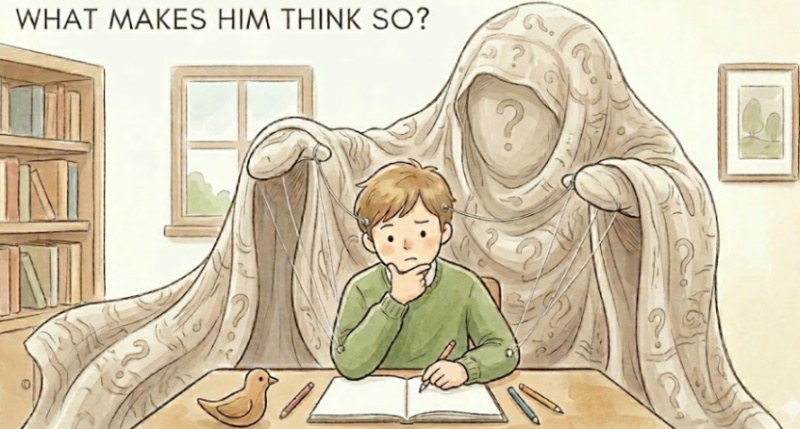
What makes him think so?
Again, the subject is an inanimate and unknown thing. Yet the sentence can sound as if that “something” was manipulating or casting a spell on him. It seems to have an intention: to make him think in a certain way.
When I look at sentences like these, I sense a kind of natural, spontaneous imagination hidden inside everyday English.
And these expressions are extremely common.
Years ago, I read The Wives, a novel by Lauren Weisberger. I remember noticing this type of sentence again and again—roughly once every couple of pages.
That frequency suggests something important. This playful way of viewing the world is not a minor feature of English. It may be one of its essential characteristics.
2. When Objects Have Mouths and Legs
The second aspect of English that feels childlike is its use of body-part metaphors.
Think about expressions such as:
- the mouth of a river
- the leg of a table
- the foot of a mountain
Of course, Japanese has similar expressions. We say 河口 and テーブルの脚, for example.
Still, English often feels more vivid to me. The original image seems easier to notice. The river really has a “mouth.” The table really has “legs.”
In Japanese, many of these expressions have become so familiar that they often feel like ordinary vocabulary rather than living metaphors.
English, at least to my ears, keeps the image more visible.
In English, similar metaphors abound:
- the legs of a table
- the head of a nail
- the face of a clock
- the hands of a clock
- the back of a book
- the neck of a bottle
In sum, English is more inclined to describe things from the viewpoint of the human body.
A book has a back, a bottle a neck, a clock a face and hands…
Seeing these expressions with fresh eyes, don’t you realize that English is more body-conscious, childlike, and alive than is generally thought?
Why This Matters
The reason I wanted to share these observations is not simply that they are interesting.
I think they can change the way we see English and English learning.
Many people imagine English as a cold, mechanical, objective language—a language of business reports, examinations, and formal communication.
But what if English is also playful?
What if it contains a child’s way of looking at the world?
If you begin to see English that way, learning it may feel different.
Instead of building an entirely new skill, you may be rediscovering something that has always been inside you.
It is a little like remembering a song you sang as a child.
Or recalling a dance you once knew by heart.
Or making a playful gesture you have not used in years, like playing peek-a-boo with a small child.
English may be more accessible than we sometimes think.
Perhaps all we need is the courage to reconnect with the child who is still somewhere inside us.

私立学校に英語教師として勤務中、40代半ばに差し掛かったころ、荒れたクラスを立て直す策として、生徒に公言して英検1級に挑戦することを思い立つ。同様の挑戦を繰り返し、退職までに英検一級(検定連合会長賞)、TOEIC満点、国連英検SA級、フランス語一級、スペイン語一級(文科大臣賞)、ドイツ語一級、放送大学大学院修士号などの成果を得る。
アメリカで生徒への対応法を学ぶ為に研修(地銀の助成金)。最新の心理学に触れた。4都県での全発表、勤務校での教員への研修を英語で行う。現在も特別選抜クラスの授業を全て英語で行っている。「どうやって単語を覚えればいいですか?」という良くある質問に答える為、印欧祖語からの派生に基づく「生徒には見せたくない語源英単語集」を執筆中。完成間近。常日頃洋書の読破で様々な思考にふれているが、そうして得た発想の一つを生かして書いた論文がコロナ対策論文として最近入賞。賞品の牛肉に舌鼓をうっている。元英検面接委員