
Hi, this is Jiro.
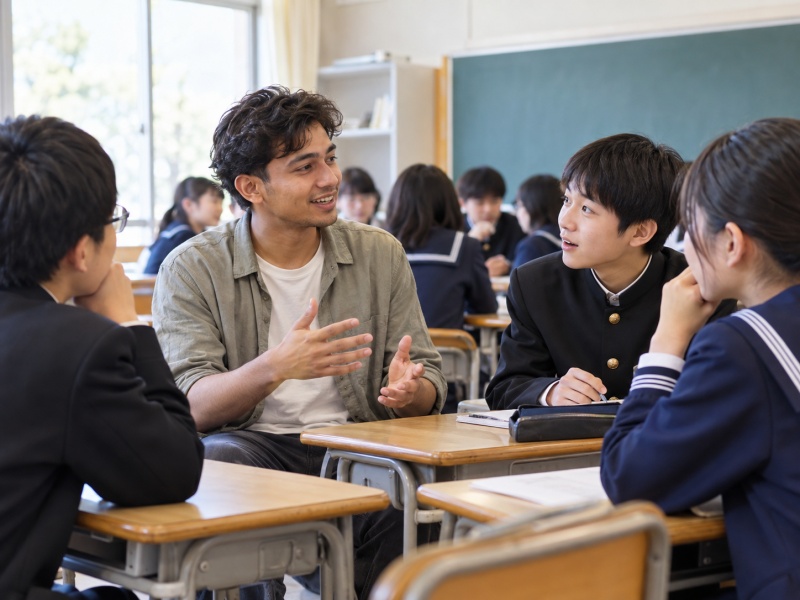
When I was teaching English at junior high and high schools, I used to invite international students and other visitors from overseas to my classes so that my students could talk with them in English.
One day, a junior high school student asked a student from Nepal:
“Have you ever climbed Mt. Fuji?”
I suppose my student was expecting an answer like:
“No, not yet. I’m really looking forward to climbing the famous Mt. Fuji!”
But the Nepalese student’s answer was quite different.
“Yes, I climbed it last weekend. That was my third time.”
He said it so casually, as if he were talking about a little hike up a hill near his home.
Somehow, I felt a little deflated. Something very important to us seemed to have been taken rather lightly.
But then I thought, “Well, Nepal is home to Mt. Everest and plenty of other mountains over 8,000 meters high. Perhaps Mt. Fuji, at less than 4,000 meters, doesn’t seem all that impressive to him.”
I shared that thought with my students later.
I said I felt Mt. Fuji had been taken lightly, but when we travel abroad and meet people from other countries, we soon realize that our own country isn’t always “number one.”
Perhaps it’s a good thing to look at our own country from a broader perspective.
Now, let me tell you about another country’s version of “our country is special.”
About 40 years ago, I visited Mumbai, India—then called Bombay—as a member of the Ship for Southeast Asian Youth Program, an international goodwill voyage organized by the Japanese government.
While I was there, local people asked me the same question again and again:
“Did you see the Queen’s Necklace?”
They were apparently talking about a highway running along the coast of Mumbai.
So one evening, after dark, I went to have a look.
What did I see?
Against the dark coastline, there were white lights, like streetlamps, stretching into the distance, one after another.
I wondered whether the sight really deserved such a grand name as “the Queen’s Necklace.”
I never had a chance to tell the local people what I honestly thought.
But, as I said, that was about 40 years ago.
Nowadays, we can easily see night views from around the world on the internet. I wonder what people in India think of the Queen’s Necklace today.
Has it been illuminated more beautifully and become more worthy of its famous name?
Or perhaps people no longer proudly recommend the Queen’s Necklace to foreign visitors as they did back then.
Now, finally, let’s talk about the weather.
We don’t usually have much of a feel for the weather in foreign countries, do we?
But even the weather can give us a chance to broaden our perspective.
I remember a time when a powerful cold air mass brought severe weather to Japan.
Weather forecasts repeatedly warned people about strong winds, with wind speeds exceeding 20 meters per second (72 kilometers per hour).
There were scenes of people struggling to walk, bicycles being blown over, and trees falling.
The commentators kept saying things like, “That’s frightening. We must be prepared!”
That reminded me of a book I had read.
Antoine de Saint-Exupéry is a French writer best known for The Little Prince.
But he was also a courageous aviator.
In a biography of Saint-Exupéry written by Stacy Schiff, I came across a passage about the fierce winds of Patagonia in South America, where wind speeds could exceed 100 kilometers per hour.
The book describes how Saint-Exupéry used to laugh about an order prohibiting pilots from landing when the wind exceeded 90 miles per hour (about 145 kilometers per hour).
With the average speed of an aircraft being nearly the same, a plane flying into such a headwind could remain almost motionless in the air—rather like a car with its engine revving while its wheels are off the ground.
If Saint-Exupéry were alive today, perhaps he would be astonished to see us making such a fuss about winds of 20 meters per second.
Of course, I’m not saying that we shouldn’t prepare for dangerous weather.
Just to be clear!
Taking precautions is one thing. Broadening our perspective is another.
Through our own experiences overseas, or through books written in English and other foreign languages, I hope we can all enjoy discovering new ways of looking at the world.
See you soon!
P.S.
Saint-Exupéry: A Biography by Stacy Schiff

私立学校に英語教師として勤務中、40代半ばに差し掛かったころ、荒れたクラスを立て直す策として、生徒に公言して英検1級に挑戦することを思い立つ。同様の挑戦を繰り返し、退職までに英検一級(検定連合会長賞)、TOEIC満点、国連英検SA級、フランス語一級、スペイン語一級(文科大臣賞)、ドイツ語一級、放送大学大学院修士号などの成果を得る。
アメリカで生徒への対応法を学ぶ為に研修(地銀の助成金)。最新の心理学に触れた。4都県での全発表、勤務校での教員への研修を英語で行う。現在も特別選抜クラスの授業を全て英語で行っている。「どうやって単語を覚えればいいですか?」という良くある質問に答える為、印欧祖語からの派生に基づく「生徒には見せたくない語源英単語集」を執筆中。完成間近。常日頃洋書の読破で様々な思考にふれているが、そうして得た発想の一つを生かして書いた論文がコロナ対策論文として最近入賞。賞品の牛肉に舌鼓をうっている。元英検面接委員