
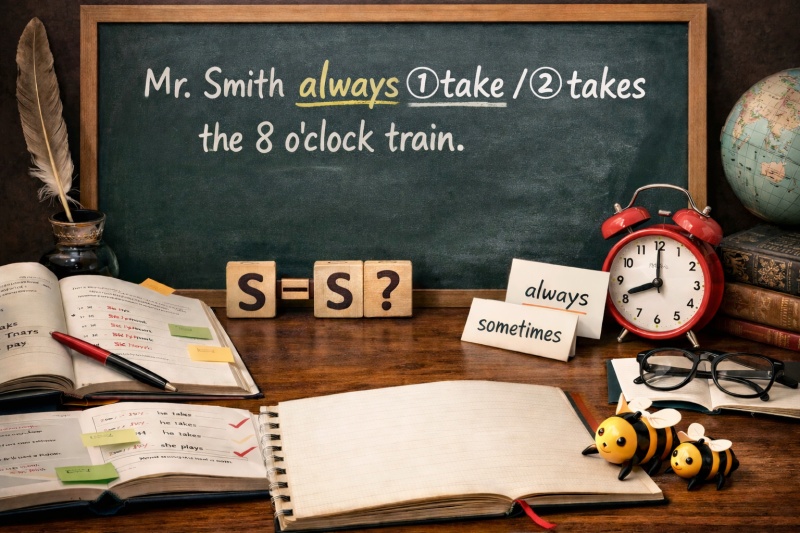
Hi, this is Jiro.
Quiz Time!
Which is correct?
Mr. Smith always ① take / ② takes the eight o’clock train.
Answer: ②
Many of my junior high students chose ① instead.
Why?
The word “always” confused them. When “always” sits between the subject and verb, students forget about the -s. The word “always” already has an “s” sound and letter, so students think they don’t need another -s.
Just as many students answered wrongly when I used “sometimes” instead of “always.” But when I removed these words completely, they got it right!
Another Surprise
Look at this question:
Which is correct?
These bees ① collect / ② collects honey.
The answer is clearly ①, but many students chose ②. Why?
They mixed up two different kinds of “-s”:
Plural noun -s (bees, dogs, cats)
Third person singular verb -s (walks, talks, eats)
Because they learned plural “-s” first, it confused them later with verb “-s.”
The Big Question: Why does English have this -s rule?
Japanese verbs don’t change based on who does the action. So Japanese students naturally wonder: “Why this trouble?”
Answer #1: History
The verb -s is what remains from old English grammar (around 1000 AD). Back then, verbs changed much more! For example, the verb “love”:
I lovie
You lovast
He lovath
They loviath
Now we only have “he loves.” Much simpler, right?
Answer #2: The Fun Explanation
Imagine you’re talking about someone not here. You want to emphasize your point:
“He talksssss so rudely to his staff!”
“She drivesssss her Porsche crazily!”
That emphasized “-s” sound stayed in English as the third person -s!
Today’s Lesson:
The third person singular -s is actually very simple. It’s just ONE rule. Don’t think too much about it. Accept it and practice until it becomes natural.
Happy English learning!

私立学校に英語教師として勤務中、40代半ばに差し掛かったころ、荒れたクラスを立て直す策として、生徒に公言して英検1級に挑戦することを思い立つ。同様の挑戦を繰り返し、退職までに英検一級(検定連合会長賞)、TOEIC満点、国連英検SA級、フランス語一級、スペイン語一級(文科大臣賞)、ドイツ語一級、放送大学大学院修士号などの成果を得る。
アメリカで生徒への対応法を学ぶ為に研修(地銀の助成金)。最新の心理学に触れた。4都県での全発表、勤務校での教員への研修を英語で行う。現在も特別選抜クラスの授業を全て英語で行っている。「どうやって単語を覚えればいいですか?」という良くある質問に答える為、印欧祖語からの派生に基づく「生徒には見せたくない語源英単語集」を執筆中。完成間近。常日頃洋書の読破で様々な思考にふれているが、そうして得た発想の一つを生かして書いた論文がコロナ対策論文として最近入賞。賞品の牛肉に舌鼓をうっている。元英検面接委員