
Hi!
This is Jiro.
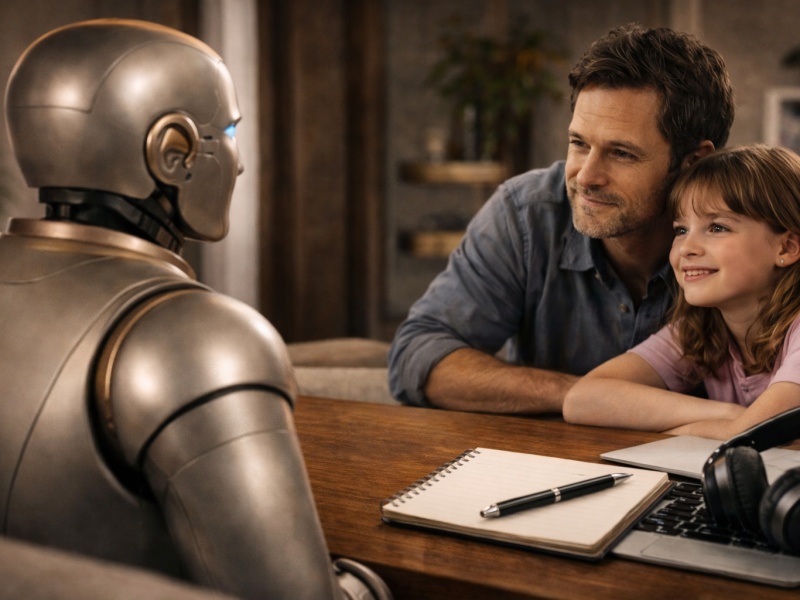
Recently, I watched a free movie on YouTube called “Bicentennial Man” with Robin Williams, my favorite actor.
Today I want to share this interesting experience with you.
Here is a quiz for you:
What did the robot call himself?
Choose one: ① one ② I ③ you
・
・
・
The answer is… (drum roll) all three!
Let me explain.
① “One” (most surprising to me)
At first, the robot called himself “one.” For example:
・”Will that be one’s name?” (one’s = my)
・”One is always glad to be of service.” (One is = I am)
I was very surprised! I only knew “one” meaning “people in general,” like:
・”One is mortal.” (= People are mortal)
・”One must be kind to others.” (= We must be kind to others)
I did some research. Using “one” to mean “I” is very old, very formal, and sounds like you have no feelings.
② “I” (most common)
Because “one” surprised me so much, I read the original novel “The Positronic Man” by Isaac Asimov. In the novel, the robot never says “one”! Instead, he always says “I, I, I, I, I…”
Of course, “I” is the most normal way to talk about yourself.
③ “You” (even more surprising!)
In the novel, I found this sentence: “You are a robot.”
I thought, “Is there another robot? Who is ‘you’?”
I did more research. In English, people sometimes use “you” when talking to themselves, especially when encouraging themselves:
・”You can do it!”
・”You should calm down.”
In Japanese, we say “I can do it” or “I should calm down.” We always use “I” when talking to ourselves.
Do you remember the famous Japanese song that starts “I am foolish, such a fool…”? Everyone knows this song! If the singer had said “You are a fool,” it would be an insult to another person!
It seems English speakers think more objectively, even about themselves.
④ When “one” changed to “I”
In the novel, the robot always says “I.” But in the movie, he starts by saying “one, one, one…”
Then suddenly, he stops saying “one” and starts saying “I.” When do you think this happened?
It happened when the robot wanted to be free. He says to his owner: “I want to be free” (not “one wants to be free”).
Here, the movie makers used language to show the robot’s new feeling of independence and self-awareness. This was a great idea!
My recommendation
I was impressed by the movie, so I read the original novel. That was interesting too.
Honestly, reading English books is usually hard for me. But if you watch an interesting movie in English first, that can help you very much when you try to read the book.
I recommend watching a movie you like, then reading the book version. It’s a good way to learn! Happy learning!

私立学校に英語教師として勤務中、40代半ばに差し掛かったころ、荒れたクラスを立て直す策として、生徒に公言して英検1級に挑戦することを思い立つ。同様の挑戦を繰り返し、退職までに英検一級(検定連合会長賞)、TOEIC満点、国連英検SA級、フランス語一級、スペイン語一級(文科大臣賞)、ドイツ語一級、放送大学大学院修士号などの成果を得る。
アメリカで生徒への対応法を学ぶ為に研修(地銀の助成金)。最新の心理学に触れた。4都県での全発表、勤務校での教員への研修を英語で行う。現在も特別選抜クラスの授業を全て英語で行っている。「どうやって単語を覚えればいいですか?」という良くある質問に答える為、印欧祖語からの派生に基づく「生徒には見せたくない語源英単語集」を執筆中。完成間近。常日頃洋書の読破で様々な思考にふれているが、そうして得た発想の一つを生かして書いた論文がコロナ対策論文として最近入賞。賞品の牛肉に舌鼓をうっている。元英検面接委員