
Hi, this is Jiro.
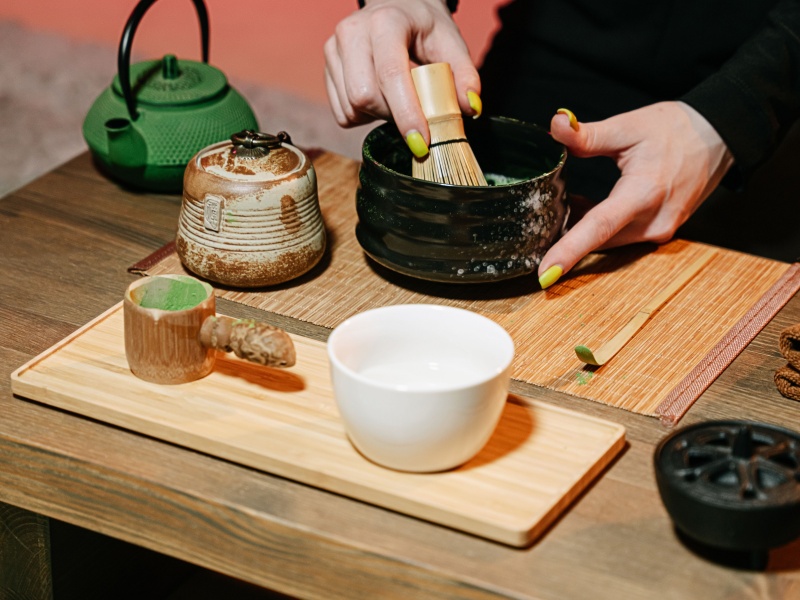
Honestly, I was of two minds when recently I was asked to guide a few visitors from London, mainly at a Japanese tea ceremony. They were the parents of a newly married Japanese-English couple who had just welcomed a baby. The baby’s mother—the only bilingual person in the family—was unable to attend the tea ceremony because she had just given birth.
Saying to myself, “I’m not a professional interpreter, so they won’t expect too much of me,” I decided to accept the job.
It turned out to be a far more enjoyable and memorable experience than I had expected. Today I’d like to share the three moments that impressed me the most.
First
I am not very familiar with Japanese tea ceremonies, so I read The Book of Tea by T. Okakura, a classic introduction to the Japanese tea ceremony.
While reading it, I came across a remarkable passage.
There are three kinds of tea: boiled tea, whipped tea, and steeped tea.
Cake tea is boiled. This is classicism.
Powdered tea is whipped. This is romanticism.
Leaf tea is steeped. This is naturalism.
When I quoted these lines, they looked both surprised and fascinated.
They even laughed when I confessed that I had read the book only the night before, just like a student cramming for an examination.
Second
In the alcove hung a scroll bearing the expression 一期一会.
When they asked me what it meant, I was ready to explain because I had often reflected on its meaning in my own daily life, just as many Japanese people have.
Literally, 一期一会 means “one opportunity, one encounter.”
People often say that history repeats itself. But does it really?
Nothing ever repeats itself exactly. Every moment happens only once. Every encounter is unique. That is why each moment, and each meeting, deserves to be treasured.
They listened quietly and thoughtfully. I had the feeling that what I truly wanted to say had reached them.
Then one of them made a comment that I will never forget.
“I think we mean almost the same thing when we say, ‘You can’t step into the same river twice.’ In fact, not even once, because the water is always flowing.”
(I later learned that this idea goes back to the ancient Greek philosopher Heraclitus.)
I was so moved that I found myself speechless for a few seconds.
It feels wonderful when you are able to exchange deep reflections through English.
Third
Because they had just become grandparents, we naturally began talking about how life changes when a child is born.
“When your child is born, your whole view of life changes.”
“Yes, indeed.”
We smiled and nodded to each other.
Moments like these are satisfying in a different way because they allow us to share simple but profound human feelings.
Looking back, accepting this request turned out to be one of the most enjoyable experiences I’ve had using English. I’m glad I didn’t turn it down.
If there is something related to English or English learning that you’ve been hesitating to do, I’d encourage you to go for it.
Like me, I think you’ll be glad you did.
Go ahead!
I’m sure it will be worth it.
Good luck!
私立学校に英語教師として勤務中、40代半ばに差し掛かったころ、荒れたクラスを立て直す策として、生徒に公言して英検1級に挑戦することを思い立つ。同様の挑戦を繰り返し、退職までに英検一級(検定連合会長賞)、TOEIC満点、国連英検SA級、フランス語一級、スペイン語一級(文科大臣賞)、ドイツ語一級、放送大学大学院修士号などの成果を得る。
アメリカで生徒への対応法を学ぶ為に研修(地銀の助成金)。最新の心理学に触れた。4都県での全発表、勤務校での教員への研修を英語で行う。現在も特別選抜クラスの授業を全て英語で行っている。「どうやって単語を覚えればいいですか?」という良くある質問に答える為、印欧祖語からの派生に基づく「生徒には見せたくない語源英単語集」を執筆中。完成間近。常日頃洋書の読破で様々な思考にふれているが、そうして得た発想の一つを生かして書いた論文がコロナ対策論文として最近入賞。賞品の牛肉に舌鼓をうっている。元英検面接委員